Announcing Biscuits
It’s been almost a year of work, but I’m finally launching Biscuits!
I’m not sure if the idea is going to quite land, here, but Biscuits is basically a collection of little software tools (hereafter: “apps”) all wrapped up in one subscription.
I mean, kind of like a Google account, except for much more niche stuff.
Why I made this
For a little while I’ve been getting into the idea of “local-first” apps (fun fact: I sorta coined “lo-fi” as a shorthand). Local-first apps are similar to the kind of web app you’re used to using (whether it’s GMail or Reddit or whatever), but with an important distinction: the data you interact with isn’t up “in the cloud,” it’s stored on your device.
You’re using a webpage as software to manipulate data you own.
This has been an exciting idea for a lot of technical people who are still leading the field in terms of defining exactly how that works. But honestly, I got a bit tired of the academic side of it all. I wanted to actually make some apps.
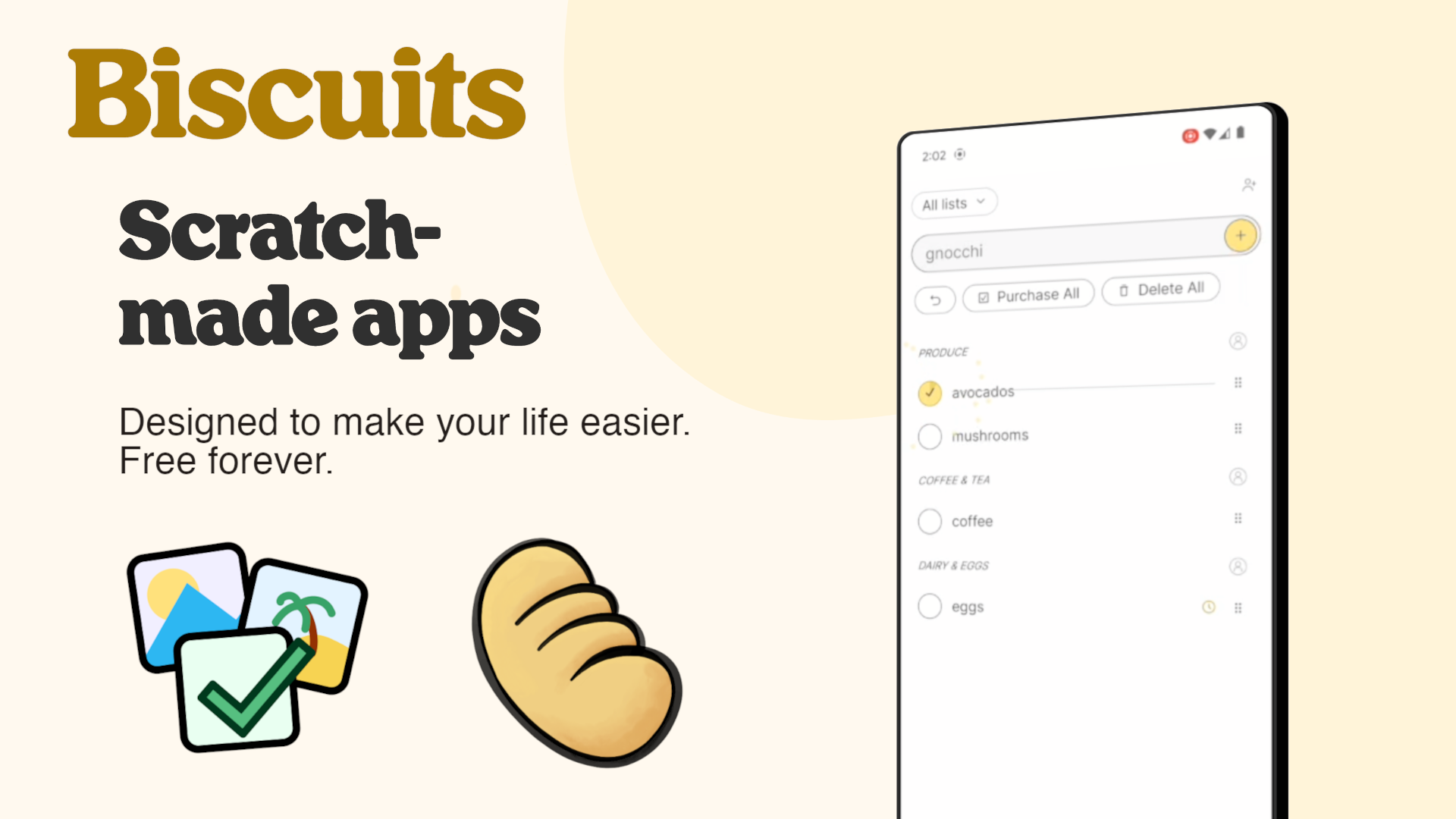
I started with Gnocchi, my groceries and cooking app. It took a very long time to get the experience down and the bugs worked out. But once I did, I was having the most fun I’ve ever had writing software.
So I started looking for my next project, and I realized… the economics of it all works out much better if I make a platform, not a bunch of disparate apps. Going big on Biscuits means I have more flexibility to make a bunch of cool local-first apps in the future!
Why I think local-first is meaningful
I mentioned how Biscuits kind of works like a Google account. Well, there are a few differences. One, a Biscuits app doesn’t store data on my servers unless you pay to. Two, I’m optimistic I can keep small “fun” apps and experiments alive for longer than Google. These two points are related.
When you use a Google service (just an example - basically everyone does this), you’re storing data on their servers and making queries and HTTP requests and even interacting with real-time collaboration, all for “free.” Of course we all vaguely understand that “free” isn’t really free here. Somehow, they’re getting some money out of your existence in their world. Probably advertising, right? Or selling your data.
Biscuits flips this around. Because a local-first app stores data on your device, not my servers, it’s actually free for me when you use it. I don’t have access to your data at all, so I couldn’t do shady stuff even if I wanted to. But I don’t have to monetize your usage to offset costs (what costs?), so I don’t! On the other hand, if you want to use things like sync or collaboration (which do require servers which I pay for), I ask you to subscribe. This keeps the incentives clear and above-board. I run this platform off the revenue from your subscriptions, and I have no reason to (or intention of) otherwise “monetizing” you with shady tactics. You get what you pay for. Isn’t it a little weird that we can’t say that about a lot of software?
The hidden costs of the internet’s weird profit models
Businesses need some kind of revenue to stay operational. At least, long term they do. And I like to think long-term and sustainably, personally. I have the luxury to since I don’t have investors.
You get this pernicious problem when your method of getting revenue doesn’t actually align with delivering user value (or worse, runs counter to it). The business start to emphasize the parts of their product people don’t like (sponsored content, etc) and de-emphasize the useful things that are the most valuable to them. The first part happens because things users don’t like are usually the things that make money—because they extract “value” (money) from those users. Why the second part, though? Well, if the user’s not paying for something and it’s providing that user a lot of value, that’s a net negative for the business providing it. Either they’re spending a lot of resources providing something for free, or at the very least they’re missing out on a chance to make you pay for it.
When businesses have spent a lot of time and energy just acquiring users in hopes of being rewarded by investors for “growing,” eventually the bill comes due. Investors expect the business to turn those users into cash. It really seems like a lot of idealistic builders don’t see this part coming. Sometimes this is the point where they sell the business to people who are more willing to do the dirty work of “extraction.” Sometimes they just go with the flow and do it themselves. I don’t want to do either.
I suspect these toxic dynamics are at play in a lot of what makes the internet both more powerful than it ever was, and also feel less friendly and useful somehow (to me at least).
I also think that the economic model which propped up a lot of this behavior (venture capital et al) is not gonna look the same that much longer.
At the end of the day I think all this stuff is why the products we used to find helpful have gradually eroded into frustrating or hollow experiences. Consider how hard it is to view your wish list in the Amazon app, for example. Amazon has UX designers and product researchers. They did that on purpose - and one can only speculate why. But it’s silly. As a user, I want to keep track of things I want or need and make careful purchasing decisions over time. As a business, Amazon wants me to Buy Now—not put it on a list to think about. Could things be better if the people providing our software had better incentives?
I’m probably not going to change all that
But I hope I can at least make the kinds of useful tools that the big guys aren’t incentivized to make. Starting with Gnocchi and Trip Tick, and more to come!
So give them a try (it’s free — like actually free!). And consider signing up if you find them as useful as I do 🙂
— Grant